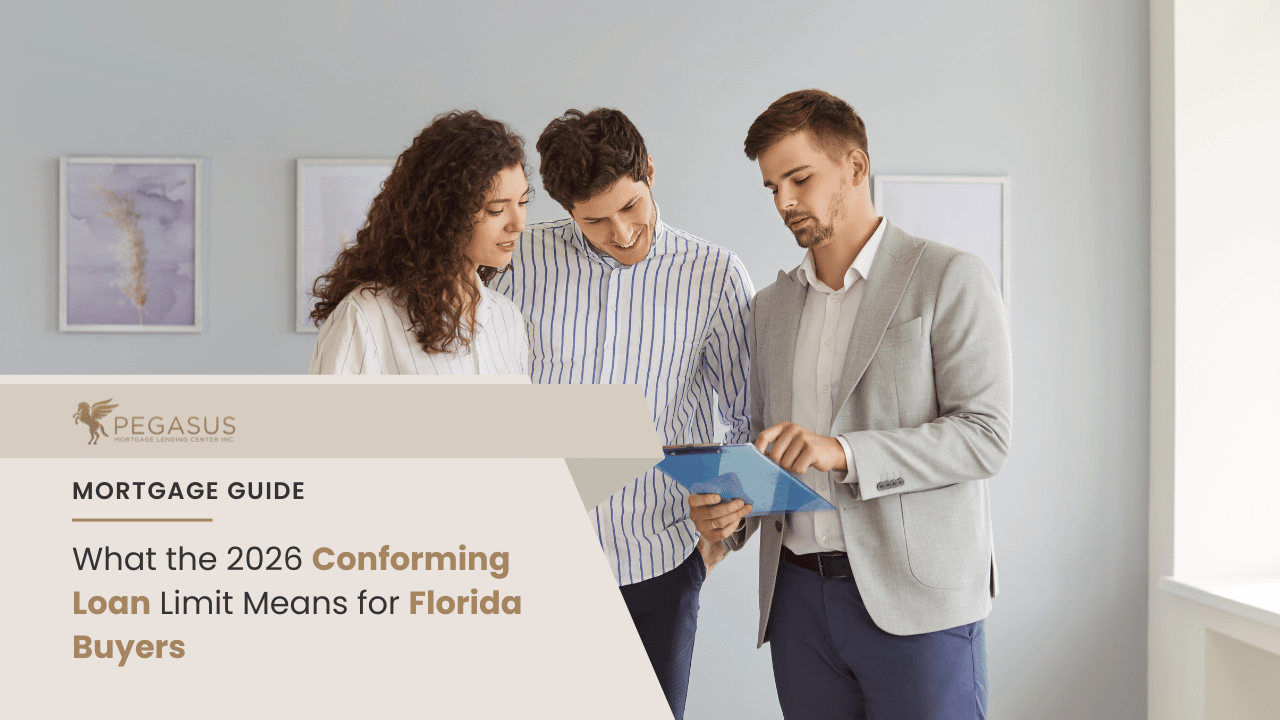
Buying a home in Florida is hard enough without mortgage rules changing in the background. The good news is that the new conforming loan limit for 2026 gives many buyers more room to borrow without automatically moving into jumbo financing.
For most Florida counties, the 2026 conforming loan limit for a one-unit property is $832,750. That is up from $806,500 in 2025. For buyers in higher-priced areas, the exact limit may be different by county.
This guide explains what that change means, how conforming loans compare with jumbo loans, and how the new limits can affect your buying power, down payment strategy, and approval path.
What Is a Conforming Loan?
A conforming loan is a mortgage that meets the lending standards set by Fannie Mae and Freddie Mac. One of the biggest rules is the maximum loan amount, also called the conforming loan limit.
Conforming loans usually follow standard rules for:
- maximum loan size
- credit profile
- debt-to-income ratio
- property type and occupancy
- documentation and underwriting
Because these loans fit a standardized framework, lenders often view them as less complex than jumbo loans.
That can translate into:
- more flexible qualification guidelines in some cases
- lower down payment options for qualified buyers
- pricing that may be more favorable than jumbo financing
Key takeaway: A conforming loan is a conventional mortgage that stays within Fannie Mae and Freddie Mac loan-size limits and underwriting standards.
What Is the New Florida Conforming Loan Limit for 2026?
For most Florida counties, the 2026 conforming loan limit for a one-unit home is $832,750. That is an increase of $26,250 from the 2025 baseline of $806,500.
The Federal Housing Finance Agency adjusts conforming loan limits each year based on changes in home prices. For 2026, the baseline increased by 3.26%.
That increase matters because it lets more Florida buyers stay within conforming territory even as home prices continue to rise.
A quick example
Let’s say you want to buy a home for $875,000.
If you put 5% down, your loan amount would likely stay above the baseline conforming limit, which could push you into jumbo financing.
If you put 10% down, your loan amount would be about $787,500, which is below the 2026 baseline limit for most Florida counties.
That difference could affect:
- the loan program you qualify for
- your documentation requirements
- your rate and reserve requirements
- how much flexibility you have during underwriting
Decision checkpoint: If your target loan amount is close to the county limit, a slightly larger down payment may help you stay in conforming territory.
Are Conforming Loan Limits the Same in Every Florida County?
No. Most Florida counties use the national baseline loan limit, but some higher-cost areas may have higher limits.
That is why buyers should not assume the same number applies everywhere in Florida. The county matters, and so does the number of units in the property.
For example:
- a one-unit primary home may use one limit
- a duplex, triplex, or four-unit property uses a higher limit
- certain higher-cost counties may have limits above the baseline
The safest move is to verify the current county-specific limit before you make an offer or structure your down payment.
Key takeaway: Loan limits are based on the property’s location and unit count, not just the state.
 How Conforming Loan Limits Affect Buying Power
 How Conforming Loan Limits Affect Buying Power
Higher loan limits do not guarantee approval, but they can expand your financing options.
Here is how the 2026 increase may help Florida buyers:
- You may be able to borrow more without using a jumbo loan.
- You may have more flexibility with your down payment strategy.
- You may qualify for a conventional option that is easier to manage than jumbo financing.
- You may keep more cash available for reserves, closing costs, or repairs.
Just remember: the loan limit applies to the loan amount, not the purchase price.
A buyer can purchase a home above the conforming limit and still use a conforming loan if the down payment is large enough to bring the loan amount below the applicable cap.
Conforming Loans vs. Jumbo Loans
A jumbo loan is a mortgage that exceeds the conforming loan limit for the property’s location and unit count. Because jumbo loans fall outside standard agency limits, lenders often apply stricter underwriting.
Conforming loan
- stays within the county loan limit
- follows standard agency guidelines
- may offer lower down payment options for qualified borrowers
- may be easier to qualify for than a jumbo loan
Jumbo loan
- exceeds the county loan limit
- often requires stronger credit and more reserves
- may involve stricter documentation
- can be useful for higher-priced homes when the loan amount is too large for conforming financing
Bottom line: If your loan amount exceeds the local conforming limit, you are typically looking at a jumbo mortgage instead of a conforming one.
What Happens If the Home Price Exceeds the Conforming Loan Limit?
This is where many buyers get tripped up.
A home price above the conforming limit does not automatically mean you need a jumbo loan. What matters is the final loan amount after your down payment.
For example, if a home costs $900,000 and you put enough down to keep the loan amount under your county’s conforming limit, you may still qualify for a conforming mortgage.
If the loan amount ends up above the applicable limit, the lender will usually treat it as a jumbo loan.
That can affect:
- minimum down payment expectations
- reserve requirements
- qualifying standards
- documentation depth
- approval timeline
Common Mistakes Florida Buyers Make
Many buyers focus only on the purchase price and miss the details that drive financing.
Here are some common mistakes:
- Confusing home price with loan amount. The limit applies to the mortgage size, not the sale price.
- Assuming every Florida county has the same limit. Some areas may differ.
- Forgetting about unit count. Multi-unit properties have higher conforming limits.
- Waiting too long to check financing. A pre-approval can reveal whether you are on track for conforming or jumbo.
- Ignoring down payment strategy. A modest increase in down payment can sometimes keep a loan below the threshold.
Why Professional Help Matters
Online calculators can help with rough estimates, but they cannot always catch the details that affect real approval options.
A mortgage professional can help you look at:
- your target purchase price
- estimated loan amount
- county-specific limits
- conforming versus jumbo trade-offs
- down payment options
- how your credit, income, and reserves shape the best path forward
That matters because two buyers looking at the same home price can end up with very different financing outcomes depending on their cash available, debt profile, and structure of the loan.
Example scenario
A buyer wants to purchase a Florida home priced just above the baseline limit and assumes jumbo financing is the only option.
After reviewing the numbers, they find that a larger down payment brings the loan amount back under the county’s conforming limit. That opens up a conventional conforming option that may be easier to qualify for than the jumbo alternative.
No strategy fits every borrower, but this is exactly why it helps to review the full picture before making an offer.
 FAQs
FAQs
 FAQs
FAQsWhat is the conforming loan limit in Florida for 2026?
For most Florida counties, the 2026 conforming loan limit for a one-unit property is $832,750. Some counties may have higher limits.
Do conforming loan limits change every year?
They can. The Federal Housing Finance Agency typically updates conforming loan limits annually based on home price data.
Are conforming loans and jumbo loans the same?
No. A conforming loan stays within the applicable loan limit and follows agency guidelines. A jumbo loan exceeds that limit.
What happens if my loan amount is above the conforming limit?
Your mortgage will usually be treated as a jumbo loan, which may come with stricter qualification requirements.
Do loan limits apply to multi-unit properties?
Yes. Duplexes, triplexes, and four-unit properties have higher conforming loan limits than one-unit homes.
Can I still buy a home above the conforming limit?
Yes. You may still use a conforming loan if your down payment brings the loan amount below the county limit.
Final Takeaways
If you are buying in Florida, the 2026 conforming loan increase may give you more flexibility than you had last year.
Here are the three big takeaways:
- The new baseline conforming loan limit for most Florida counties is $832,750 for a one-unit property.
- The loan limit applies to the loan amount, not the purchase price.
- A larger down payment may help you avoid jumbo financing, depending on the county and property type.
Before you make an offer, review your target price range, estimated down payment, and county-specific limit. That will give you a much clearer sense of whether a conforming or jumbo loan makes more sense.
Stop guessing and get your numbers reviewed. A mortgage professional can help you compare options, understand the trade-offs, and choose a loan strategy that fits your budget and goals.
Disclaimer: Mortgage rules, loan limits, and eligibility guidelines may change. This article provides general educational information and should not be considered financial advice. Always confirm details with a licensed mortgage professional before making decisions.
Sources & References
Federal Housing Finance Agency (FHFA) – 2026 Conforming Loan Limits Announcement
Official government release explaining the updated conforming loan limits and the methodology used to adjust them annually based on home price changes.
https://www.fhfa.gov/news/news-release/fhfa-announces-2026-conforming-loan-limit-values
Federal Housing Finance Agency – House Price Index (HPI)
Explains how home price changes influence annual conforming loan limit adjustments.
https://www.fhfa.gov/data/hpi
Fannie Mae – Conforming Loan Limits and Underwriting Guidelines
Details conforming loan eligibility standards and loan limit tables used by lenders.
https://singlefamily.fanniemae.com/originating-underwriting/loan-limits
Freddie Mac – Loan Product Advisor and Conforming Loan Requirements
Overview of underwriting standards and requirements for conforming mortgages.
https://www.freddiemac.com/singlefamily/loan-product-advisor
Consumer Financial Protection Bureau – Mortgage Loan Basics
Government consumer guide explaining mortgage types, including conventional and jumbo loans.
https://www.consumerfinance.gov/owning-a-home/
Mortgage Bankers Association – Conventional vs Jumbo Loan Overview
Industry association guidance explaining differences between conforming and jumbo loans.
https://www.mba.org
FHFA Conforming Loan Limits Historical Data
Shows historical loan limits and how they have changed over time.
https://www.fhfa.gov/data/conforming-loan-limit
JVM Lending – Florida Conforming Loan Limits Overview
Explains how conforming loan limits apply in Florida counties, including high-cost areas.
https://www.jvmlending.com/blog/florida-conforming-loan-limits
Mortgage Calculator – History of Conforming Loan Limits
Background information on conforming loan limits and market impacts.
https://www.mortgagecalculator.org/helpful-advice/conforming-loan-limits.php